Key Points:
- Diplomatic Insult Turned Tourism Campaign: National tourism organization Visit Norway launched an international advertising campaign showcasing its architectural roadside restrooms following disparaging remarks by US President Donald Trump.
- Origin of Controversy: Speaking at a campaign rally in Michigan, Trump criticized Norway as a “shithouse country” and stated he did not want immigrants from the nation, linking his grievances to being passed over for the Nobel Peace Prize.
- Official Government Reaction: Norwegian Foreign Minister Espen Barth Eide publicly responded to the remarks, reiterating that the Nobel Committee is entirely independent of the Norwegian government.
- Architectural Showcase along Scenic Routes: The campaign highlights award-winning restrooms positioned along Norway’s 18 National Tourist Routes, including facilities on the Helgeland coast and overlooking the Aurlandsfjord.
- Global Digital Engagement: According to data reported by Bloomberg News and Innovation Norway, the travel feature attracted approximately 80,000 unique views across 173 countries within days of launch.
Norway (Norway Post Magazine) October 31, 2026 – Norway’s official tourism board, Visit Norway, has launched a cheeky international marketing campaign featuring its world-renowned roadside restrooms in direct response to derogatory comments made by United States President Donald Trump. As reported by Bloomberg News and The Guardian on Thursday, 29 October 2026, the state-backed agency Innovation Norway turned political controversy into a viral promotional drive under the headline “Are these the world’s best sh– houses?”. Featuring photographs of designer public conveniences situated along fjords, mountain passes, and northern coastlines, the campaign has logged around 80,000 individual page views from users across 173 countries, including South Korea, Germany, and Canada.
- Key Points:
- What prompted US President Donald Trump’s derogatory remarks about Norway?
- How did Norwegian government officials and tourism directors respond to the comments?
- Which specific public restrooms were featured in Visit Norway’s promotional campaign?
- Background of Norway’s National Tourist Routes and Public Infrastructure Investment
- International Tourism Traffic, Public Relations, and Diplomatic Communications
What prompted US President Donald Trump’s derogatory remarks about Norway?
As reported by international news agency AFP and political correspondents at WION, US President Donald Trump issued a sharp tirade against Norway during a campaign rally held in Michigan ahead of the upcoming US midterm elections.
During his address to supporters, President Trump voiced renewed frustration over being overlooked for the Nobel Peace Prize, claiming he had settled multiple global conflicts without receiving formal international recognition. As reported by The Guardian, Trump stated to the crowd: “Frankly, Norway sucks. Norway has become a shithouse country, actually,” adding that he would no longer welcome immigrants from the Nordic nation “because I didn’t get the Nobel Prize”.
Trump further criticized the Nobel Committee’s recent decision to award the Nobel Peace Prize to former International Criminal Court judge Navi Pillay, calling the choice an “indelible stain” on the country.
How did Norwegian government officials and tourism directors respond to the comments?
As reported by The Guardian and regional media outlets, Norwegian Foreign Minister Espen Barth Eide responded to the American president’s public comments by emphasizing the strict separation between state governance and the Nobel Prize selection body.
As reported by AFP, Foreign Minister Espen Barth Eide stated: “He [Trump] knows very well that the Nobel Committee is independent. We have reminded him of that, in case anyone is wondering — and that is still the case”.
Rather than issuing an angry diplomatic rebuke, Norway’s national tourism board chose to deploy lighthearted satire. As reported by Bloomberg News, Anne-Signe Fagereng of Visit Norway explained the decision to capitalize on the media coverage, stating: “Trump’s remarks certainly weren’t positive — he used the term ‘sh–houses’ — but we actually have fantastic toilets”.
Anne-Signe Fagereng added that the facilities featured in the campaign form part of Norway’s official National Tourist Routes, designed specifically to showcase the nation’s natural geography alongside modern Scandinavian architecture.
Simultaneously, Evgenia Egorova, a senior consultant at Visit Norway, told public broadcaster NRK: “The world needs a little laugh. We thought: let’s meet them with kindness, and a little humour”.
Which specific public restrooms were featured in Visit Norway’s promotional campaign?
As reported by architectural journal DesignCurial and covered by Pragmatika, Visit Norway highlighted several famous public conveniences constructed along the nation’s 18 designated National Tourist Routes. Many of these facilities were engineered by leading Scandinavian architectural firms to blend directly into the surrounding wilderness.
The featured facilities showcased in the global campaign include:
- Stegastein Viewpoint Restroom (Sognefjord): Located in western Norway, this structure features minimalist lines and one-way, black-tinted glass windows that allow visitors panoramic views over the Aurlandsfjord while maintaining privacy from the outside. It was previously named among the ten best public toilets in the world by DesignCurial.
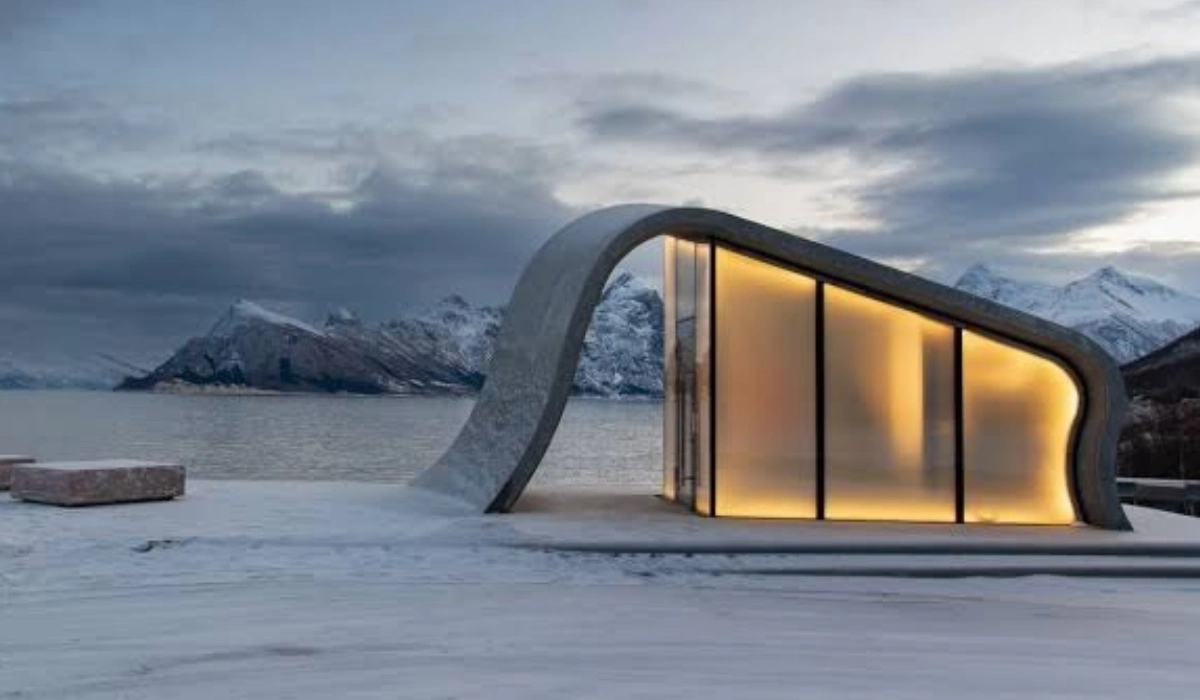
- Uredd Rest Area / Ureddplassen (Helgeland Coast): Situated on the wild northern coastline, this wave-shaped concrete and glass facility provides views of the open sea and northern lights, frequently cited by international travel magazines as the world’s most beautiful public toilet.
- Ersfjordstranda “Golden Toilet” (Senja Island): A distinctive, geometric triangular structure clad in gold-colored aluminum plates set against a white sand beach backdrop.
- Ostasteidn Restroom (Ryfylke): Designed with concrete walls engineered to cultivate natural moss growth over time, allowing the structure to act as camouflage within the landscape.
- Utsikten Viewpoint (Gaularfjellet): A solar-powered modernist concrete rest facility positioned at the crest of a mountain pass.
Visit Norway accompanied the digital campaign with social media captions declaring “Norway makes toilets great again” and reassurances to international travelers that the facilities are “worth a visit, both when you really have to go, and when you don’t”.
Background of Norway’s National Tourist Routes and Public Infrastructure Investment
Norway’s National Tourist Routes project was formally initiated by the Norwegian Public Roads Administration (Statens vegvesen) in 1994 to enhance 18 selected road stretches passing through the country’s most dramatic landscapes. Spanning over 2,000 kilometers across coastlines, fjords, and alpine passes, the multi-decade infrastructure initiative combined road improvements with high-concept architectural rest stops, viewing platforms, and art installations.
Over the past thirty years, the Norwegian government has commissioned renowned architectural firms—including Snøhetta, Saunders Architecture, and Peter Zumthor—to design public amenities along these transit corridors. Rather than installing standard prefabricated utility blocks, the project prioritized structural sustainability, using local stone, untreated timber, glass, and solar integration to turn necessary rest stops into architectural landmarks. The resulting public facilities have won numerous international design awards and form a core component of Norway’s eco-tourism infrastructure strategy.
International Tourism Traffic, Public Relations, and Diplomatic Communications
The viral reception of Visit Norway’s satirical campaign is predicted to generate measurable benefits for the country’s tourism sector while offering a case study in crisis communication.
For Norwegian tourism operators and regional businesses along the National Tourist Routes, the sudden influx of international media attention is predicted to drive increased summer self-drive bookings for 2027. Market analysts note that by reframing a hostile political comment into an invitation to explore Scandinavian design and wilderness, Visit Norway successfully engaged high-value demographic markets in North America, Western Europe, and East Asia without spending significant advertising capital.
For international public relations strategists and diplomatic corps, Norway’s response demonstrates the effectiveness of self-deprecating humor and cultural confidence in defusing political slurs. Rhetoric experts at the University of Bergen noted that by refusing to adopt a defensive posture, Norwegian institutions stripped the original political insult of its rhetorical force, establishing a template for how national tourism boards can navigate political friction using digital agility.