Key Points:
- What did the Oslo District Court decide regarding Meta’s new commercial terms?
- Which media organizations are involved in the lawsuit against Meta?
- What structural changes did Meta attempt to introduce to its Commercial Terms?
- What three demands have Norwegian publishers placed on Meta?
- Background of EU Digital Markets Policy and Platform-Publisher Negotiations
- European Competition Law, Media Revenues, and Global AI Training
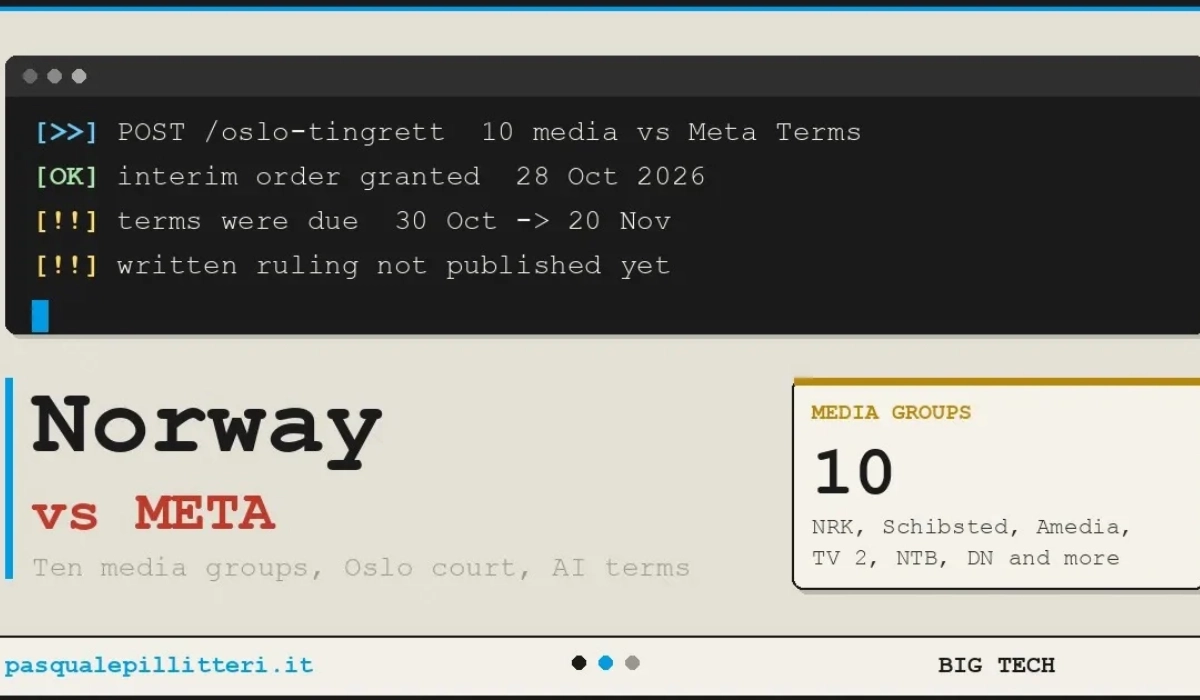
- Court Injunction Issued: The Oslo District Court granted an urgent interim injunction prohibiting tech giant Meta from enforcing its updated commercial terms for Facebook and Instagram business accounts in Norway until their legal compliance is fully established.
- Coalition of Media Houses: The lawsuit was initiated by Mediebedriftenes Landsforening (MBL) on behalf of ten major Norwegian publishing entities, including public broadcaster NRK, commercial network TV 2, Schibsted, Amedia, Polaris, Aller, Mentor Medier, Dagens Næringsliv (DN), national news agency NTB, and local outlet Hordaland Folkeblad.
- Core Legal Dispute: Publishers argue that Meta’s proposed commercial terms grant the platform sweeping rights to harvest articles, photographs, and videos—including content behind digital paywalls—using automated crawlers and test credentials to train artificial intelligence models.
- Financial Penalty for Meta: Following the urgent ruling, the court ordered Meta to pay 1 million Norwegian kroner (approximately £81,000) in legal costs.
- Publishers’ Core Demands: The Norwegian media coalition outlined three compulsory conditions: written guarantees respecting opt-out mechanisms like
robots.txt, voluntary licensing agreements with fair financial compensation for AI training, and non-discrimination guarantees against outlets that decline the terms.
Norway (Norway Post Magazine) October 31, 2026 – The Oslo District Court issued an urgent interim injunction on Wednesday, 28 October 2026, barring Meta Platforms from introducing its updated commercial terms across Facebook and Instagram business accounts in Norway. According to court documents and statements released by media industry representatives, the legal intervention followed a lawsuit filed on 27 October by ten leading Norwegian publishing organizations. Represented by the Norwegian Media Businesses’ Association (MBL), the coalition accused Meta of attempting to forcibly scrape editorial content—including paywalled articles, videos, and photography—to develop and refine its artificial intelligence tools. The court’s order freezes the implementation of Meta’s revised terms pending a comprehensive trial examining potential abuses of market dominance under competition law.
What did the Oslo District Court decide regarding Meta’s new commercial terms?
As reported by media law correspondents for Euronews and Press Gazette, the Oslo District Court granted the interim injunction requested by the Norwegian publishing coalition, effectively prohibiting Meta from implementing its proposed Commercial Terms for professional account holders in Norway.
According to legal reports published by Agence France-Presse (AFP) and Sweden’s TT news agency, the presiding judge rendered an urgent ruling without holding an initial oral hearing for Meta. The injunction keeps Meta’s contractual changes on hold until Norwegian judicial authorities evaluate whether the platform’s terms constitute an illegal abuse of a dominant market position under national and European competition laws.
Reacting to the ruling, Lene Eltvik Vindfeld, Chair of the MBL Board, expressed satisfaction with the court’s swift action, stating that the judge acknowledged Meta’s dominant position within the relevant digital advertising and social distribution market. Lene Eltvik Vindfeld noted that the court recognized the unreasonable nature of the terms, alongside the grave risk that news organizations could permanently lose operational control over valuable intellectual property accumulated over decades.
Additionally, as reported by public broadcaster NRK, the court ordered Meta to pay 1 million Norwegian kroner (approximately £81,000) to cover court costs incurred by the plaintiffs.
Which media organizations are involved in the lawsuit against Meta?
As reported by technology correspondents at PPC Land and press releases issued by publisher Amedia, the legal action represents an unprecedented unified front across Norway’s media ecosystem.
The ten media entities filing through MBL comprise:
- NRK: Norway’s national public service broadcaster.
- TV 2: The country’s largest commercial television network.
- Amedia: Norway’s largest publisher of editorially managed local media, operating 108 regional newspapers.
- Schibsted: Major international media group owning national titles including VG and Aftenposten.
- Polaris Media & Mentor Medier: Leading regional and niche publishing conglomerates.
- Aller Media: Key national magazine and digital content publisher.
- Dagens Næringsliv (DN): Norway’s premier financial and business daily newspaper.
- NTB: The national Norwegian press agency.
- Hordaland Folkeblad: Independent regional newspaper representing local print and digital journalism.
What structural changes did Meta attempt to introduce to its Commercial Terms?
As reported by Euronews and Nieman Lab, Meta originally unveiled broad revisions to its global Commercial Terms on October 8, setting an initial implementation date of October 30. Following intense pushback from European publishers and preliminary scrutiny from antitrust regulators, Meta subsequently pushed back the rollout date to November 20, claiming the delay was intended to allow clearer communication with commercial partners.
The main point of contention for publishers involves a specific clause governing business accounts, Facebook Pages, and Instagram corporate profiles. The clause grants Meta contractual permission to deploy automated software tools—such as scrapers, crawlers, and test login credentials—to systematically index and harvest articles, photos, and video assets from any website linked to a commercial account. Critically, this access extends past digital paywalls, leaving account holders with no contractual mechanism to opt out.
According to legal analysis from Press Gazette, Meta attempted to soften the language in mid-October by removing explicit references to “training AI products,” substituting broader wording that authorized data collection for the “development, improvement, research, and maintenance of advertising and business products”. However, publishing executives maintain that the altered contractual language remains legally elastic enough to permit generative AI model training.
Responding to the allegations, a spokesperson for Meta stated that the revised web-crawling rules strictly apply to optimizing advertising delivery and commercial products. The spokesperson added that domain owners can communicate data preferences using standard robots.txt exclusion files. However, media analysts at Nieman Lab pointed out that no version of Meta’s formal Commercial Terms includes a legally binding commitment to honor robots.txt instructions.
What three demands have Norwegian publishers placed on Meta?
As reported by Amedia press releases and JournalismPakistan, the Norwegian media coalition established three baseline requirements that Meta must meet before any commercial agreement can be finalized:
- Contractual Recognition of Opt-Outs: Meta must provide explicit, written contractual guarantees committing to honor technical exclusion protocols, specifically including
robots.txtinstructions on publisher domains. - Voluntary Licensing & Compensation: Any scraping or indexing of journalistic content for artificial intelligence training or product development must occur exclusively through voluntary, negotiated licensing agreements that include appropriate financial compensation.
- Protection Against Platform Penalties: Publishers that refuse to grant Meta permission to scrape their proprietary content must be protected against algorithmic retaliation, ensuring they do not suffer reduced distribution, lowered reach, or account suspension on Facebook and Instagram.
Background of EU Digital Markets Policy and Platform-Publisher Negotiations
The conflict in Norway marks a new battleground in the long-standing global struggle between big technology platforms and news organizations over intellectual property and fair compensation. Under the European Union’s Copyright Directive and national digital market regulations across Nordic countries, publishers have attempted to establish collective bargaining frameworks to secure licensing revenue when tech platforms display or process editorial content.
Previously, digital platforms sought web content primarily through public web crawling, leading infrastructure providers such as Cloudflare to enable automated crawler blocking, while social networks like Reddit curtailed public RSS access to prevent uncompensated data scraping. Meta’s approach differs by using terms of service contracts to secure broad data collection rights. By tying content collection rights directly to the commercial terms required to maintain official brand pages on Facebook and Instagram, publishers argue Meta created an “all-or-nothing” ultimatum, forcing businesses to choose between relinquishing their copyright protections or abandoning access to vital social media audiences.
European Competition Law, Media Revenues, and Global AI Training
The Oslo District Court’s interim injunction against Meta is predicted to establish a far-reaching precedent across European competition law, contract regulation, and the broader artificial intelligence industry through 2026 and into 2027.
For international news publishers and commercial brand managers, the Norwegian court victory provides a strategic framework to challenge unilateral terms of service updates. Media antitrust lawyers predict that publisher associations across the European Union, the United Kingdom, and Australia will cite the Oslo ruling to launch parallel legal actions and antitrust complaints. If courts across Europe echo the Norwegian ruling by declaring forced contract-based AI scraping an abuse of market dominance, tech conglomerates will be forced to abandon mandatory platform-wide terms in favor of individual, paid content-licensing agreements with news organizations.
For Meta and major artificial intelligence developers, the temporary block in Norway restricts the pool of high-quality, real-time editorial data available for model refinement. If Meta fails to overturn the injunction during full trial proceedings, it will either need to incorporate explicit, legally binding opt-out protections into its global terms or establish substantial licensing budgets to compensate media houses. Failure to reach an amicable resolution risks prompting major news brands to delete their official social media channels entirely, fracturing platform engagement and accelerating regulatory scrutiny from the European Commission.