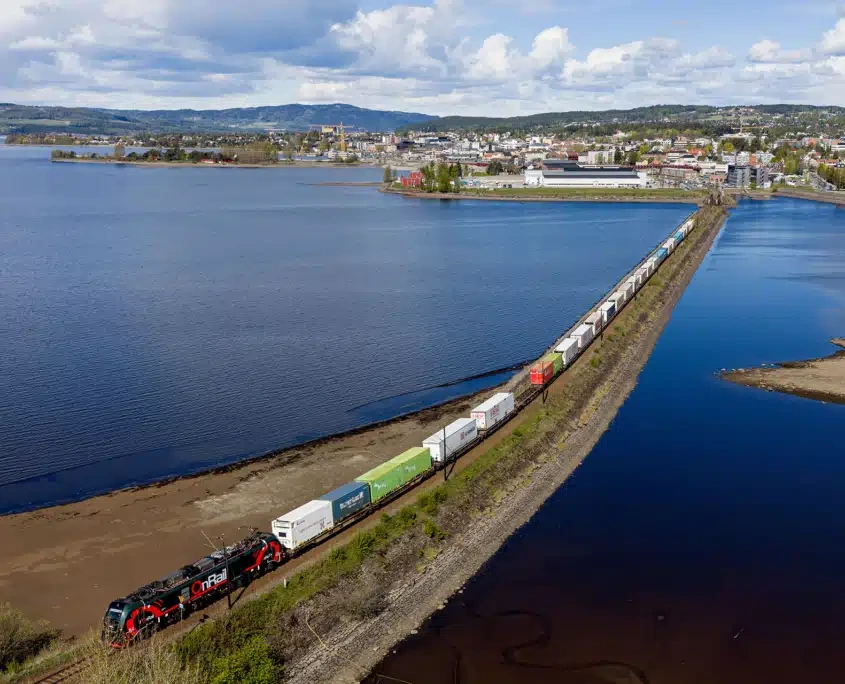
- Norwegian railway operator OnRail, ferry operator Wasaline, Kvarken Ports Umeå, and the Port of Trondheim have partnered to develop a new intermodal freight corridor linking Finland, Sweden, and Norway.
- The proposed east–west transport route connects Vaasa in Finland, Umeå in Sweden, and Trondheim in Norway by combining Wasaline’s daily ferry crossing with a planned electric rail freight service.
- Enabled by the completed electrification of Norway’s Meråker Line between Trondheim and the Swedish border at Storlien, the planned rail service will use electric locomotives to haul containers, semi-trailers, and industrial goods without diesel traction.
- Freight arriving at the Port of Trondheim will connect with onward maritime services, offering shorter export distances from northern Scandinavia to markets including the United Kingdom and Iceland.
- The project addresses Nordic supply chain resilience and concerns over potential disruptions to traditional Baltic Sea and Kattegat north–south shipping routes, while also holding relevance for cross-border military logistics.
- Separately, OnRail is preparing to launch a new freight train service between Trondheim and Oslo on 1 February 2027, creating an additional link between the northern corridor and Norway’s capital.
Norway (Norway Post Magazine) November 12, 2026 – Transport and port operators across Finland, Sweden, and Norway have launched plans to establish a new combined sea and electric rail freight corridor linking Vaasa, Umeå, and Trondheim. Spearheaded by Norwegian railway operator OnRail, ferry company Wasaline, Kvarken Ports Umeå, and the Port of Trondheim, the initiative connects Wasaline’s existing Gulf of Bothnia ferry route with a proposed electric freight train service across Sweden and Norway. Supported by the recent electrification of Norway’s Meråker Line, the east–west corridor aims to provide northern Scandinavian industries with a low-emission alternative to Baltic Sea shipping routes, shorten transit times to the United Kingdom and Iceland, and strengthen regional transport resilience.
- What Are the Key Operational Components of the Proposed Nordic Freight Corridor?
- How Do the Participating Partners and Infrastructure Links Integrate Across the Three Countries?
- Background of the Particular Development After the News
- How This Development Can Affect Nordic Exporters, Logistics Operators, and Regional Supply Chain Resilience
As reported by Felix Seifert of Trondheim Havn and maritime correspondents at Shippax and Splash247, the four logistics partners have initiated collaborative project work to establish an integrated east–west transport artery across the Nordic region. Under the proposed operational structure, cargo will travel across the Gulf of Bothnia aboard Wasaline’s ferry service between the Finnish port of Vaasa and the Swedish port of Umeå. From Umeå, freight will transfer onto a planned rail freight connection running westwards through central Sweden to the Port of Trondheim on the Norwegian coast, where goods can subsequently access onward international maritime routes.
As reported by Railway-News and official project disclosures from Wasaline and the Port of Trondheim, the planned railway link between Umeå and Trondheim will utilise electric locomotives capable of transporting containers, semi-trailers, and industrial goods with zero direct emissions. Norwegian rail freight operator OnRail—headed by Chief Executive Officer Henning Aandal—has indicated that it is prepared to establish and operate the cross-border train service in close cooperation with cargo owners, freight forwarders, and industrial partners. Ongoing commercial dialogues with prospective customers will directly determine both the operational frequency and haulage capacity of the future rail link.
A foundational infrastructure milestone enabling the cross-border rail proposition is the completed electrification of Norway’s Meråker Line. The railway corridor connects Trondheim with the Norwegian–Swedish border at Storlien, where it links directly into the electrified Swedish national railway network. According to technical updates from the project partners, the electrification of this mountain border line removes the previous necessity for diesel traction on the Norwegian section, permitting continuous electric freight train operations between central Sweden and Trondheim.
As detailed in regional port announcements, traditional Scandinavian cargo flows predominantly follow a north–south axis, relying heavily on maritime transit through the Baltic Sea and the Kattegat strait for imports and exports. By extending the existing Kvarken Corridor—jointly supported by the ports of Vaasa and Umeå—westwards by rail to the Atlantic coast at Trondheim, the partners aim to offer northern Scandinavian businesses a substantially shorter export pathway to western markets, specifically highlighting destinations such as the United Kingdom and Iceland.
Furthermore, the initiative is advancing amid heightened focus on infrastructure security and supply chain resilience across the Nordic states. Project partners noted that industrial enterprises in northern Scandinavia have raised concerns regarding potential disruptions to Baltic Sea shipping lanes during a future crisis or emergency. As reported by Shippax and regional defence logistics observers, the rail corridor running through Trondheim, Meråker, and Storlien has also drawn strategic attention for its potential role in military logistics, including the rapid movement of military personnel and heavy equipment from the Norwegian coast toward Sweden and Finland.
In a related operational development, OnRail is separately preparing to inaugurate a new domestic rail freight service connecting Trondheim and Oslo on 1 February 2027. Once operational, that north–south domestic connection is expected to provide an additional logistical link between the proposed east–west northern corridor and the Norwegian capital. Meanwhile, on the maritime leg of the route, Wasaline—part of Stena Line—already operates a daily year-round passenger and freight ferry service between Vaasa and Umeå using the Aurora Botnia, a hybrid vessel powered by batteries and biogas.
What Are the Key Operational Components of the Proposed Nordic Freight Corridor?
Project disclosures from OnRail, Wasaline, Kvarken Ports Umeå, and the Port of Trondheim outline the primary infrastructure and operational elements forming the cross-border route:
- Maritime Ferry Leg (Vaasa–Umeå): Operated daily year-round by Wasaline across the Gulf of Bothnia—the northernmost year-round international ferry route globally—utilising the hybrid biogas-and-battery vessel Aurora Botnia.
- Cross-Border Electric Rail Leg (Umeå–Trondheim): A planned freight rail service operated by OnRail using electric locomotives to haul containers, semi-trailers, and industrial cargo across central Sweden and via Norway’s electrified Meråker Line through Storlien.
- Atlantic Maritime Gateway (Port of Trondheim): Managed by intermunicipal company Trondheim Havn IKS, providing deep-water maritime connections for onward export shipments to the United Kingdom, Iceland, and wider international ports.
- Domestic Norwegian Rail Extension (Trondheim–Oslo): A separate OnRail freight service scheduled to commence on 1 February 2027, linking the western terminus of the corridor directly with southern Norway.
How Do the Participating Partners and Infrastructure Links Integrate Across the Three Countries?
Coordination among maritime operators, port authorities, and rail carriers connects distinct national transport networks into a single intermodal chain:
| Partner / Infrastructure | Country / Jurisdiction | Core Role in the Freight Corridor |
|---|---|---|
| Wasaline & Port of Vaasa | Finland / Sweden | Operates daily hybrid ferry service (Aurora Botnia) across the Kvarken Strait between Vaasa and Umeå. |
| Kvarken Ports Umeå | Sweden | Serves as the Swedish maritime-to-rail intermodal hub connecting Gulf of Bothnia ferries with the Swedish rail network. |
| OnRail & Meråker Line | Norway / Sweden | Planned electric freight rail operator utilising the electrified Trondheim–Meråker–Storlien railway link. |
| Port of Trondheim (Trondheim Havn IKS) | Norway | Provides the western Atlantic port terminus for onward sea freight to the UK, Iceland, and global markets. |
Background of the Particular Development After the News
Historically, trade and industrial exports from northern Finland and northern Sweden have depended heavily on maritime transport navigating southwards through the Gulf of Bothnia, the Baltic Sea, and the Kattegat strait before reaching North Sea and Atlantic shipping lanes. While effective under normal peacetime commercial conditions, this reliance creates long transit distances for cargo bound for western destinations such as the United Kingdom and North America, while exposing supply chains to winter sea-ice constraints and geopolitical bottlenecks in the Baltic Sea.
The completion of Norway’s multi-billion-kroner electrification programme on the Trønder and Meråker railway lines—finalised in late 2025—eliminated a long-standing technical barrier between the Swedish and Norwegian rail networks. Previously, freight trains crossing at Storlien required diesel locomotives on the Norwegian gradient down to Trondheim, limiting capacity and increasing carbon emissions. Combined with strengthened Nordic defence and infrastructure integration, this upgraded rail link has enabled commercial operators to design viable, low-emission east–west transport corridors across the Scandinavian peninsula.
How This Development Can Affect Nordic Exporters, Logistics Operators, and Regional Supply Chain Resilience
The establishment of an intermodal sea-and-rail freight corridor between Vaasa, Umeå, and Trondheim is projected to influence commercial logistics and regional infrastructure across several areas:
1. Reduced Transit Distances and Emissions for Northern Industrial Exporters
For forestry, mining, energy technology, and manufacturing enterprises in western Finland and northern Sweden, shifting cargo onto a direct east–west electric rail and hybrid ferry route offers shorter transit times to Atlantic ports in the United Kingdom and Iceland while lowering Scope 3 transport emissions compared to long-haul Baltic shipping or road haulage.
2. Enhanced Supply Chain Redundancy and Crisis Resilience
For Nordic industrial shippers and civil preparedness authorities, establishing a high-capacity western outlet via the Port of Trondheim reduces single-route dependency on the Baltic Sea and Kattegat, ensuring continuity of essential imports, exports, and strategic logistics during geopolitical tensions or maritime disruptions.
3. Expanded Intermodal Network Integration for Rail and Port Operators
For OnRail, Wasaline, and the port authorities in Vaasa, Umeå, and Trondheim, aligning cross-border rail schedules with daily ferry crossings—and linking them to OnRail’s upcoming Trondheim–Oslo freight service in February 2027—will increase terminal utilisation and create new commercial cargo flows across central and northern Scandinavia.