Key Points
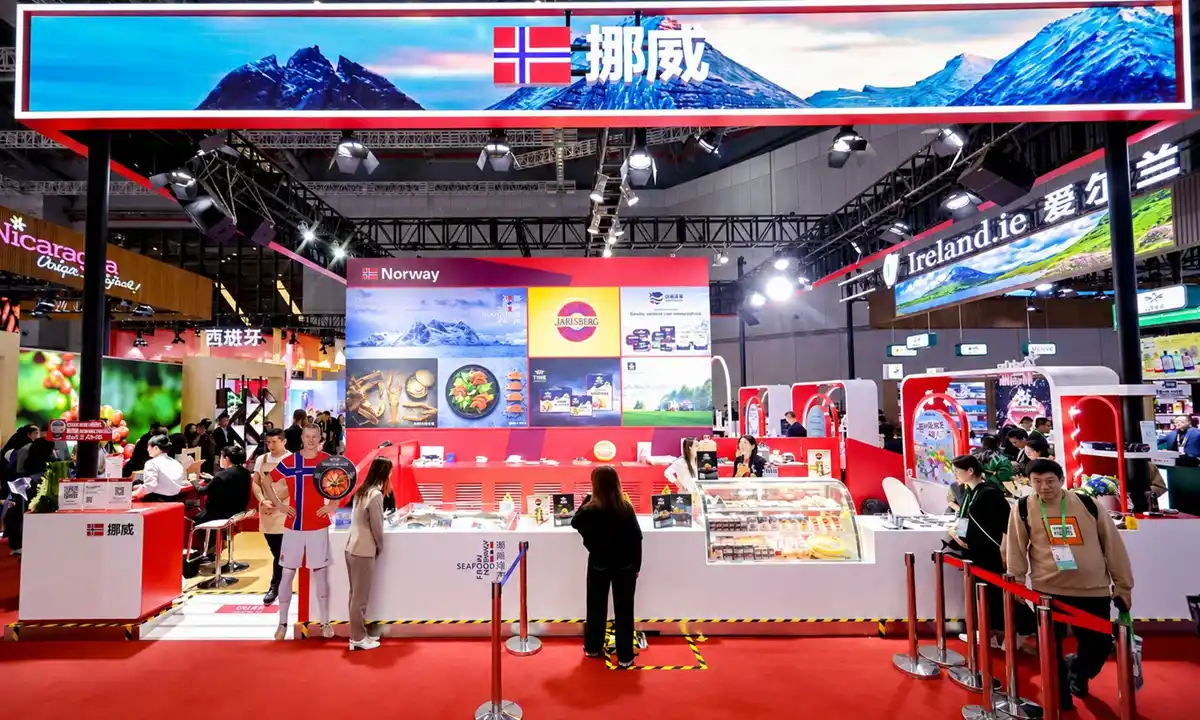
- The Norwegian Seafood Council unveiled a new “Target 2035” initiative at the ninth China International Import Expo in Shanghai to raise annual seafood exports to China to 20 billion yuan ($3 billion) by 2035.
- China surged to become Norway’s second-largest seafood export market in 2026, up from third place in 2025, driven by a 26 per cent year-on-year increase in export value during the first nine months of the year.
- Between January and September 2026, Norwegian seafood shipments to China reached 158,230 tonnes, valued at approximately 8.3 billion yuan.
- The new 2035 framework succeeds the previous “Target 2025” plan, which reached 85 per cent of its 10 billion yuan target by the end of 2025 following COVID-19 pandemic disruptions and currency fluctuations.
- China’s General Administration of Customs and the Norwegian Ministry of Industry, Commerce and Fisheries signed a new regulatory protocol expanding Chinese market access for Norwegian wild-caught seafood.
- Cold-water prawns and salmon products represent core growth drivers, with China already serving as Norway’s largest global export market for cold-water prawns.
Norway (Norway Post Magazine) November 6, 2026 – Norway has launched an ambitious long-term commercial strategy to expand its annual seafood exports to China to 20 billion yuan ($3 billion) by 2035. Unveiled on Friday, 6 November 2026, during the ninth China International Import Expo (CIIE) in Shanghai, the “Target 2035” initiative reflects growing trade momentum after China rose to become Norway’s second-largest seafood export destination in 2026. Supported by a newly signed bilateral protocol expanding market access for Norwegian wild-caught seafood, the Norwegian Seafood Council (NSC) confirmed plans to increase capital investments, expand logistics partnerships, and meet evolving Chinese consumer demand across modern retail and e-commerce platforms.
- What Are the Strategic Priorities of Norway’s “Target 2035” Seafood Initiative?
- How Rapidly Are Norwegian Seafood Shipments to China Growing in 2026?
- What Consumer Trends and Regulatory Agreements Are Driving Growth in China?
- Background of the Particular Development After the News
- How This Development Can Affect Norwegian Seafood Producers, Chinese Retailers, and Global Logistics Networks
What Are the Strategic Priorities of Norway’s “Target 2035” Seafood Initiative?
As reported by business correspondents covering the ninth China International Import Expo in Shanghai, the “Target 2035” framework established by the Norwegian Seafood Council represents a doubling of previous commercial targets, positioning mainland China as a primary long-term growth engine for Norwegian maritime exports.
Speaking at the trade exposition in Shanghai, Cecilie Myrseth, Norway’s Minister of Industry and Commerce, stated: “China is an important trading partner for Norway, and seafood is an important pillar of bilateral trade relationship.” Minister Myrseth emphasized the necessity of deepening structural supply chain ties, adding: “It is important to further strengthen cooperation and connections across the seafood value chain and respond to the evolving needs of Chinese consumers, and I look forward to promoting Norwegian businesses in China this week.”
The new 2035 roadmap replaces the previous “Target 2025” strategy, which was established in 2017 with an objective of achieving 10 billion yuan in annual exports by 2025. According to official NSC data, Norwegian seafood exports reached 8.5 billion yuan by the end of 2025, fulfilling 85 per cent of the original target. The council attributed the shortfall to global trade disruptions caused by the COVID-19 pandemic and volatile foreign exchange movements, but confirmed that ongoing 2026 trade volumes are expected to cross the 10 billion yuan mark before the conclusion of the current calendar year.
How Rapidly Are Norwegian Seafood Shipments to China Growing in 2026?
According to statistical reports released by the Norwegian Seafood Council at CIIE, trade volumes between Norway and Chinese importers expanded at a rapid pace during the first nine months of 2026.
From January to September 2026, Norway exported 158,230 tonnes of seafood to China, generating approximately 8.3 billion yuan in total value. This performance represents a 15 per cent increase in volume and a 26 per cent surge in export value compared to the corresponding period in 2025. Industry analysts noted that Norway’s growth in export value to China was the second-fastest among its top 15 global seafood destinations, elevating China from Norway’s third-largest seafood market in 2025 to its second-largest market in 2026.
Reaffirming the industry’s commitment to the Chinese market, Sigmund Bjørgo, China Director of the Norwegian Seafood Council, stated: “From the ‘Target 2025 Plan’ to the new ‘Target 2035’, our confidence in the long-term potential of the China market remains strong. This is not a journey we intend to take alone.” Bjørgo stressed that the NSC will continue to invest heavily in consumer marketing while collaborating closely with Chinese commercial importers, distributors, and processing partners to fulfill the 2035 export vision.
What Consumer Trends and Regulatory Agreements Are Driving Growth in China?
As reported in statements provided to global trade media, the expansion of Norwegian seafood presence coincides with structural changes in Chinese retail infrastructure and new bilateral customs agreements.
Analysing consumer market shifts, Yao Qifei, Vice President of the China Aquatic Products Processing and Marketing Alliance, stated: “China’s seafood market is undergoing continuous evolution, with consumers paying increasing attention to freshness, health value, convenience, and value for money.” Yao noted that these shifting preferences create distinct commercial opportunities, forcing industry players to innovate product offerings for diverse consumption scenarios, including direct-to-door instant delivery and premium cold-chain e-commerce channels.
China’s overall seafood import market demonstrated strong capacity in 2025, importing 4.5 million tonnes valued at 145.3 billion yuan, with imports of salmon products alone expanding by 50 per cent. While Atlantic salmon remains a premier product, cold-water prawns have emerged as another major growth category, with China now standing as Norway’s largest global export destination for the commodity.
Trade expansion has been further facilitated by official diplomatic protocols. A separate statement provided by the NSC confirmed that China’s General Administration of Customs recently signed a new formal protocol with the Norwegian Ministry of Industry, Commerce and Fisheries. The regulatory agreement establishes an updated inspection and quarantine framework governing Norwegian wild-caught seafood, removing administrative barriers and broadening legal market access for exporters entering Chinese ports.
Background of the Particular Development After the News
The launch of the “Target 2035” initiative represents the continuation of a long-term economic recovery and expansion process in Sino-Norwegian diplomatic and commercial relations. Bilateral trade experienced significant friction following political disagreements in 2010, resulting in informal trade barriers, delayed customs inspections, and restricted import quotas for Norwegian salmon. Normalization of diplomatic ties in late 2016 paved the way for the original “Target 2025” roadmap announced in 2017, designed to reposition Norwegian seafood as a mainstay of China’s premium urban diet.
Over the past decade, Norway’s seafood sector heavily modernized its cold-chain supply infrastructure, establishing direct air-freight routes from Oslo to major Chinese aviation hubs, including Beijing, Shanghai, Guangzhou, and Chengdu. This logistics network reduced transit times for fresh Atlantic salmon to under 72 hours from harvest to retail shelves. The signing of the latest market access protocol for wild-caught species at the 2026 China International Import Expo extends Norway’s footprint beyond farmed salmon into cod, haddock, and cold-water shrimp, reinforcing bilateral ties as China expands its high-level opening-up policies for global agricultural products.
How This Development Can Affect Norwegian Seafood Producers, Chinese Retailers, and Global Logistics Networks
The execution of Norway’s $3 billion export roadmap will generate distinct commercial outcomes across international aquaculture producers, Chinese retail ecosystems, and specialized freight transport networks.
Impact on Norwegian Exporters and Aquaculture Farmers
For Norwegian seafood producers and coastal aquaculture enterprises, committing to a $3 billion target in China will require substantial capital allocation toward production capacity, cold-storage technology, and compliance monitoring. Exporters will increasingly tailor product lines specifically for Chinese consumer preferences, prioritizing ready-to-cook packaging, pre-portioned fillets, and certified sustainable wild-caught species. Smaller Norwegian producers seeking to enter Asian markets will benefit from the standardized bilateral protocol, which reduces regulatory friction and customs clearance delays at Chinese ports of entry.
Impact on Chinese Retail, Foodservice, and E-Commerce Operators
For Chinese supermarkets, premium seafood restaurants, and instant-delivery e-commerce platforms (such as Freshippo and JD.com), guaranteed supply flows of high-grade Norwegian seafood will support market expansion into second- and third-tier Chinese cities. Distributors will leverage the “freshness and health” marketing points emphasized by the NSC to capture rising middle-class consumer expenditure. Increased volume guarantees will also allow Chinese processors and distributors to negotiate stable long-term supply contracts, insulating domestic retail prices from sudden global market swings.
Impact on Air Freight and Cold-Chain Logistics Providers
For international logistics operators and cargo airlines, scaling trade to 20 billion yuan by 2035 will necessitate a major expansion of temperature-controlled freight capacity between Scandinavia and East Asia. Cargo carriers operating routes between Norway and China can expect sustained demand for dedicated charter flights. Concurrently, domestic Chinese cold-chain logistics providers will need to invest in specialized storage and distribution hubs near major coastal ports and international airports to maintain product integrity across urban delivery networks.