Key Points
- Three Joint Air Defence Projects: Ukrainian President Volodymyr Zelensky confirmed that Ukraine and Norway are actively collaborating on three joint air defence initiatives, including specialized counter-drone equipment aimed directly at neutralizing Russian Shahed drones.
- Timeline for Shahed Countermeasures: Zelensky revealed that equipment for the first project has demonstrated strong initial results, with specialized hardware expected to arrive in Ukraine within one and a half to two months to bolster Sky protection against Shahed strikes.
- FREYJA and Satellite Communications: The second joint initiative centers on FREYJA, a European anti-ballistic missile defence programme, while the third project addresses broader air defence capabilities and dedicated satellite communications for the Ukrainian Armed Forces.
- High-Level Bilateral Engagements: The announcements followed a morning meeting in Oslo between President Zelensky, Norwegian Prime Minister Jonas Gahr Støre, Defense Minister Tore Sandvik, and executives from Norwegian defense manufacturing firm Kongsberg, the primary producer of NASAMS air defence systems.
- Funding Gap and Parliamentary Engagement: Zelensky briefed leaders of all Norwegian parliamentary parties and Storting Speaker Masud Gharahkhani, expressing gratitude for Norway’s cross-party coalition while calling for support to close a critical €3.5 billion ($4.1 billion) defense funding shortfall for the current financial year.
Norway (Norway Post Magazine) October 21, 2026 – Ukrainian President Volodymyr Zelensky has announced that Ukraine and Norway are actively developing three joint air defence projects, with the first initiative yielding tangible results designed to counter Russian Shahed kamikaze drones. Speaking to journalists following consultations in Oslo with Norwegian Prime Minister Jonas Gahr Støre, Defense Minister Tore Sandvik, and executive representatives from defense manufacturer Kongsberg, Zelensky outlined operational timelines for specialized counter-drone hardware expected within two months. The talks also encompassed European anti-ballistic missile initiatives, military satellite communications, and urgent diplomatic requests to bridge an remaining $4.1 billion defense budget deficit.
- What Are the Details of the Three Joint Air Defence Projects Announced by President Zelensky?
- How Is Defence Manufacturer Kongsberg Participating in Ukraine’s Sky Protection?
- What Did President Zelensky Discuss with Norwegian Parliamentary Leaders Regarding Funding Gaps?
- How Does This Visit Connect to Broader Peace Talks and US Diplomatic Meetings in Norway?
- Background of the Particular Development
- Prediction: How This Development Can Affect Air Defence Operations and European Security Stakeholders
What Are the Details of the Three Joint Air Defence Projects Announced by President Zelensky?
As reported by Ukrinform’s special correspondent monitoring the diplomatic talks in Oslo, President Volodymyr Zelensky informed media representatives during a group briefing that Ukraine and Norway have formalized technical cooperation across three targeted air defence programs.
Outlining the first project, President Volodymyr Zelensky stated: “I want to thank our partners and inform the Ukrainian public that we are working on three projects. As they say, we can see the light at the end of the tunnel, and there are positive developments. The first project has delivered strong results, in my view. In another month and a half to two months, we expect to receive the equipment needed to protect against Shahed drones”.
As reported by Ukrinform and verified by official statements from the President’s Office, the second joint project focuses on FREYJA, a broader European anti-ballistic missile defence framework. President Zelensky extended formal gratitude to Norway for its persistent backing of the FREYJA initiative, noting that initial technical progress has been achieved on individual components and that both sides have identified specific operational areas to accelerate development so that live testing can commence by the end of 2026.
The third initiative, as reported by Ukrinform, combines specialized air defence modules with advanced military communications. Zelensky confirmed that military technical teams are working directly with Norwegian partners to establish new satellite communications capabilities designed to maintain operational command and control for Ukrainian frontline forces.
How Is Defence Manufacturer Kongsberg Participating in Ukraine’s Sky Protection?
As reported by Ukrinform and The New Voice of Ukraine, President Volodymyr Zelensky held direct high-level deliberations in Oslo with Norwegian Defense Minister Tore Sandvik and Eirik Lie, Chief Executive Officer of Norwegian defense contractor Kongsberg. Kongsberg is the co-developer and primary manufacturer of the Norwegian Advanced Surface-to-Air Missile System (NASAMS), which forms a core pillar of Ukraine’s medium-range air defence umbrella.
Reflecting on the role played by the defense firm, President Volodymyr Zelensky written in an official statement: “I met with Norwegian Defense Minister Tore Sandvik, Eirik Lie, CEO of Norwegian defense company Kongsberg, and representatives of the company, which manufactures NASAMS air defense systems. These systems effectively protect our people and critical infrastructure from Russian missile and drone attacks virtually every day. We are counting on additional defense support packages next month”.
Industry analysts observe that Kongsberg’s direct involvement across the three technical projects reflects an evolving model of defence integration, combining Norwegian advanced sensor suites and guided missile systems with Ukraine’s real-time combat data gathered during continuous drone and missile interceptions.
What Did President Zelensky Discuss with Norwegian Parliamentary Leaders Regarding Funding Gaps?
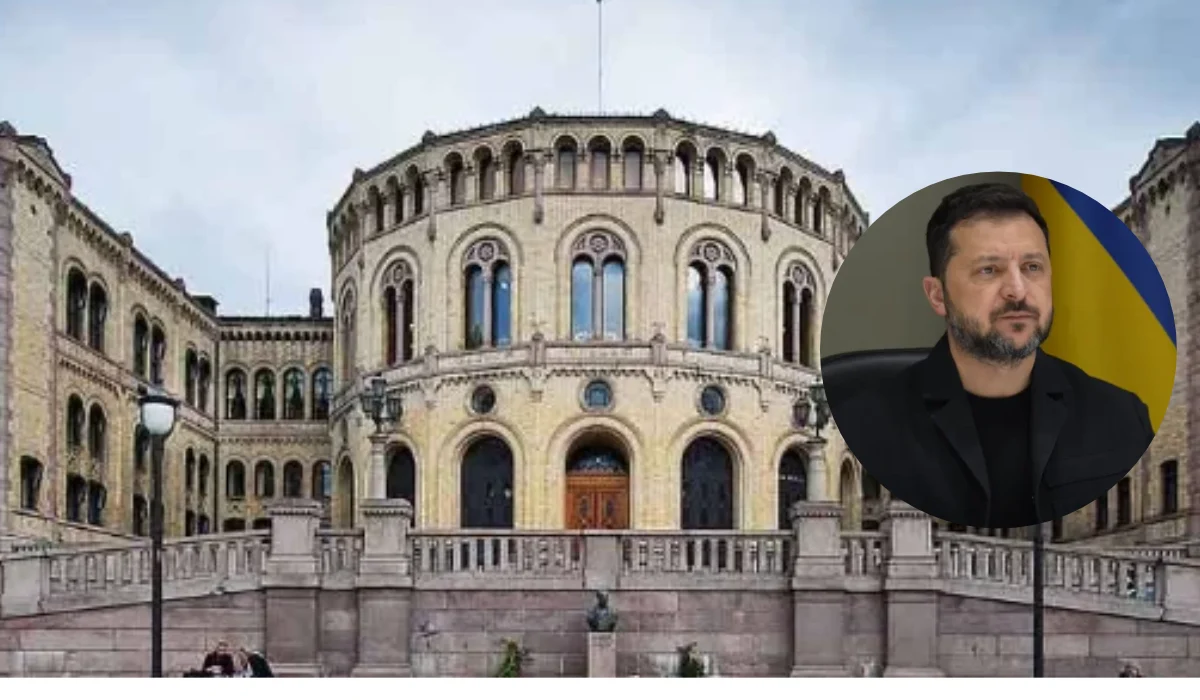
In addition to executive and defense industry meetings, President Volodymyr Zelensky engaged directly with the political leadership of the Storting, Norway’s parliament. As reported by Ukrinform, Zelensky met with Storting Speaker Masud Gharahkhani alongside representatives from every political party seated in the legislature.
In his statement to journalists, President Volodymyr Zelensky highlighted the importance of Norway’s political unity, stating: “We are grateful for this broad coalition, bringing together different parties in the Norwegian parliament in support of Ukraine. We appreciate the financial assistance”.
According to Ukrinform’s report, discussions between Zelensky and Norwegian parliamentary leaders extended beyond military hardware to cover comprehensive civilian support. The topics included dedicated energy support packages to withstand winter grid disruptions, joint diplomatic efforts to secure the return of Ukrainian children forcibly abducted by Russian forces, funding for the construction of reinforced bomb shelters, and civilian municipal bus allocation programs.
However, President Zelensky emphasized that meeting immediate military allocations remains a pressing requirement for the current fiscal cycle. Addressing the immediate financial status of the defense budget, President Volodymyr Zelensky stated: “You know that we have made good progress with the European Union. We are also grateful to our partners, but we still face a funding gap of €3.5 billion, or $4.1 billion. We are working to address it. I raised this issue with our Norwegian colleagues. (…) We hope our partners will help us”.
How Does This Visit Connect to Broader Peace Talks and US Diplomatic Meetings in Norway?
President Volodymyr Zelensky’s meetings with Kongsberg executives and parliamentary party leaders form part of an intensive diplomatic mission that commenced upon his arrival in Norway on 20 October 2026.
As reported by Ukrinform and Censor.NET, Zelensky held multi-lateral diplomatic discussions in Oslo alongside Norwegian Prime Minister Jonas Gahr Støre and Finnish President Alexander Stubb, engaging directly with Steve Witkoff, Special Envoy for U.S. President Donald Trump.
Following a second bilateral meeting with Prime Minister Støre on 21 October, President Zelensky reiterated that diplomatic progress toward a just peace relies heavily on unified international positioning and clear signals regarding Russian willingness to halt hostilities rather than expand military campaigns. During his stay in Oslo, Zelensky also met with King Haakon VIII to express gratitude on behalf of the Ukrainian nation for Norway’s sustained humanitarian, military, and financial aid.
Background of the Particular Development
The defense partnership between Oslo and Kyiv has expanded significantly under the framework of Norway’s multi-year Nansen Support Programme for Ukraine, a long-term financial package established by the Storting to deliver predictable civil and military aid. As a non-EU NATO member possessing a globally competitive defense industry, Norway has emerged as a crucial supplier of advanced surface-to-air missile batteries, anti-drone modules, radar technology, and direct financial contributions to Ukraine’s national budget.
The explicit focus on countering Shahed-type uncrewed aerial vehicles (UAVs) comes in response to altered Russian combat tactics. Throughout 2025 and 2026, Russian forces increased their deployment of Iranian-designed Shahed loitering munitions and modified variants in massed nightly salvos aimed at overwhelming urban air defence networks and targeting power generation facilities. Because utilizing high-cost interceptor missiles like the Patriot or traditional NASAMS rounds against low-cost loitering munitions is economically unsustainable over long campaigns, the Ukrainian Armed Forces and international partners like Kongsberg have focused on developing specialized, cost-effective counter-UAV (C-UAS) systems equipped with advanced optical sensors and laser-guided light rockets.
Prediction: How This Development Can Affect Air Defence Operations and European Security Stakeholders
The rollout of the three joint Norwegian-Ukrainian defense projects and the efforts to close the $4.1 billion funding shortfall will carry strategic implications across several operational domains:
- For Ukrainian Air Defence Units and Civilian Infrastructure: The arrival of specialized counter-Shahed hardware within the next 45 to 60 days will significantly bolster local point-defence networks guarding cities and power plants. By deploying targeted, cost-efficient interception tools against loitering drones, Ukraine can conserve its higher-tier NASAMS and Patriot surface-to-air missiles for higher-altitude ballistic and cruise missile threats.
- For European and NATO Defense Industrial Bases: The joint engineering between Kongsberg and Ukrainian military teams accelerates the operational testing cycle for European defense initiatives like FREYJA. Real-world battlefield integration of new satellite communications and anti-ballistic components provides NATO defense manufacturers with invaluable combat data, accelerating the development of next-generation integrated air and missile defense systems across Europe.
- For International Donors and Budget Strategists: Zelensky’s explicit highlighting of the remaining €3.5 billion ($4.1 billion) budget gap will put pressure on non-EU allies like Norway and G7 member states to finalize supplementary defense packages before the close of the current fiscal year. Successful multi-party funding arrangements in the Storting may serve as a template for other European parliaments seeking to maintain long-term, cross-party financial commitments to Ukraine.